




AI, PRIVACY, AND PROFESSIONAL RESPONSIBILITY: WHO ARE WE TRUSTING?
October 21, 2026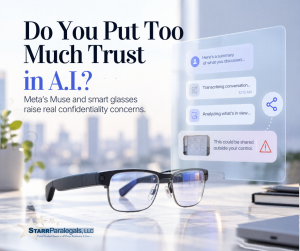
My friend Jennifer Ellis, an attorney and respected authority on legal ethics and technology, shared some disturbing information about Meta’s AI products. It’s worth reading, and it’s worth discussing.
Security researchers discovered that approximately 6,800 conversations shared through Meta’s new Muse AI assistant could be located through publicly accessible DNS records. Some contained confidential business information, financial details, internal reports, and other sensitive material. Information that users presumably never intended to make publicly discoverable. Meta has reportedly suspended the sharing feature while investigating.
Jennifer also raised concerns about Meta’s smart glasses, which have been the subject of separate investigations into privacy, recording practices, and access to personal footage.
These aren’t simply technology stories. They’re reminders of how easily convenience can outrun common sense, privacy, and professional responsibility.
And the concerns extend well beyond Meta.
We’re increasingly relying on artificial intelligence to research, write, communicate, manage information, and make decisions. But AI can hallucinate, fabricate citations, misinterpret instructions, and produce responses that sound authoritative while being completely wrong. Add the potential exposure of confidential information, and the consequences can be significant.
The responsibility doesn’t disappear because a machine did the work.
When we engage attorneys, paralegals, accountants, consultants, or other professionals, we’re placing our trust in their judgment, experience, and ability to safeguard information. We should also be asking how they use AI, what information they’re sharing with it, whether their work is independently verified, and what safeguards are in place.
Those questions are just as important for professionals evaluating the people they hire to assist them.
As someone who has spent more than four decades in the legal profession, including years working in paralegal ethics, I believe technological competence and ethical responsibility go hand in hand. Knowing how to use a tool is only part of the equation. Knowing when NOT to use it is equally important.
At StarrParalegals, LLC, professional responsibility isn’t an afterthought. It’s part of how I approach the work and the relationships I’ve built with attorneys over the years.
I use AI. I recognize its value. I also recognize its limitations, and I don’t believe we should surrender our judgment simply because technology promises to make our lives easier.
Trust is earned. Confidentiality is essential. And accountability remains human.
My thanks to Jennifer Ellis for raising these concerns and encouraging the conversation.
Ars Technica reporting: https://arstechnica.com/security/2026/10/meta-muse-exposes-users-personal-and-business-secrets-when-they-share-conversations/
Jennifer’s website: https://jlellis.net/
Leave a commentA Law Degree Does Not Make You a Lawyer
October 16, 2026
and Paralegals Know the Difference
The controversy surrounding White House Press Secretary Katie Zacharia raises an issue that extends beyond politics. It concerns the integrity of professional titles, accurate disclosure of credentials, and the public’s right to know whether someone claiming legal authority is actually licensed to exercise it.
Update: Katie Zacharia was removed from her position as this was being written. The ethical issues discussed below remain relevant because the questions about professional titles, public representations, and public trust extend beyond any one individual.
Zacharia graduated from Pepperdine University Caruso School of Law in 2011 and later took the California bar examination. She has now confirmed that she did not pass the examination, did not take it again, and is not licensed to practice law in California. Nevertheless, she has repeatedly described herself as a lawyer. She has also shared numerous social-media posts identifying her as an attorney, although she says she had previously been told not to use “attorney” or “esquire.”
Zacharia argues that she may call herself a lawyer because she earned a Juris Doctor degree and has performed substantive legal work. She also distinguishes providing “legal analysis” from giving “legal advice.”
As a legal professional, business owner, and former Chair of the National Federation of Paralegal Associations Ethics Board, I have a serious problem with that distinction.
I attended law school. I have performed substantive legal work, including transactional work, for more than four decades. I have knowledge and experience that many lawyers respect and rely upon. None of that entitles me to represent myself as a lawyer.
And I do not.
Education Is Not Licensure
A law degree is an academic credential. A license to practice law is professional authority granted by a jurisdiction.
The distinction is neither technical nor trivial. Licensure establishes that an individual has satisfied the jurisdiction’s requirements for admission and is subject to its regulatory and disciplinary authority. A degree alone does not confer that status.
The American Bar Association Model Rules recognize this distinction. Model Rule 5.5 prohibits practicing law in violation of a jurisdiction’s regulation of the profession. It also prohibits a lawyer who is not admitted in a jurisdiction from holding out to the public or otherwise representing that the lawyer is admitted there.
California law goes further. Business and Professions Code § 6126 applies not only to the unlicensed practice of law but also to a person who advertises or holds themselves out as practicing or entitled to practice law without an active license or other legal authorization. Whether Zacharia’s particular conduct violates that statute is a question for the appropriate California authorities. The statute nevertheless demonstrates why titles and public representations matter.
Paralegals Are Required to Get This Right
Paralegals understand this boundary because our ethical rules require us to understand it.
The current NFPA Code of Ethics and Professional Responsibility states plainly:
Rule 1.7: “A paralegal’s title shall be fully disclosed.”
Its accompanying ethical considerations require a paralegal’s title to clearly indicate the individual’s status in physical and digital professional communications and prohibit promotional materials that create a fraudulent impression concerning the paralegal’s status or authority.
The next rule is equally direct:
Rule 1.8: “A paralegal shall not engage in the unauthorized practice of law.”
The Code defines unauthorized practice as the practice of law by someone who does not hold a current law license, subject to limited programs or other authority expressly permitting nonlawyers to provide particular services.
These provisions are not ceremonial language. They protect clients, lawyers, paralegals, and the legal system by ensuring that the public understands who is providing a service and what authority that person possesses.
The NALA – The Paralegal Association Code of Ethics reaches the same result. Canon 1 prohibits a paralegal from engaging in, encouraging, or contributing to conduct that could constitute unauthorized practice. Canon 2 prohibits paralegals from performing duties reserved exclusively to attorneys. Canon 4 prohibits rendering independent legal judgment in place of an attorney. Canon 5 requires paralegals to disclose their status at the outset of professional relationships with clients, attorneys, courts, agencies, and members of the public.
Paralegals routinely correct people who introduce us as attorneys. We identify ourselves accurately in correspondence, meetings, court filings, websites, and public communications. We distinguish legal information and substantive legal support from independent legal advice.
We do that not because we lack knowledge, experience, or confidence. We do it because professional competence includes understanding the limits of our authority.
“Lawyer” and “Attorney” Are Not Conveniently Interchangeable Credentials
There may be limited contexts in which someone uses “lawyer” broadly to describe a person with legal education. That does not resolve the ethical issue created when the title is used publicly to establish professional credibility.
Ordinary members of the public generally understand “lawyer” to mean someone licensed and authorized to practice law. Calling oneself a lawyer during media appearances, while offering legal analysis, reinforces that understanding. Sharing materials that identify the person as an attorney compounds it.
The relevant question is not whether a carefully constructed linguistic distinction can be defended after the fact. The question is what the representation reasonably communicates to the public.
Professional disclosure should eliminate confusion, not exploit it.
Experience Does Not Supply Missing Authority
Failing a bar examination does not make someone unintelligent, unethical, or incapable of valuable work. Passing one does not guarantee competence or integrity.
That is not the point.
The point is that graduating from law school and performing legal work do not independently confer a law license. A person may accurately describe having a Juris Doctor, legal education, transactional experience, or experience analyzing legal issues. Those are substantial credentials. They are not permission to adopt a professional title that reasonably implies licensure.
Paralegals live with that distinction every day. Many of us possess decades of specialized knowledge. We draft pleadings, analyze records, investigate claims, manage discovery, prepare transactions, and help attorneys navigate complicated procedural and factual problems. We nevertheless identify ourselves as paralegals because that is our professional status.
Titles Matter Because Trust Matters
I helped develop the revised NFPA ethical standards because professional identity is inseparable from public trust. The 2022 Code expressly requires accurate disclosure, prohibits misleading impressions about status, and bars unauthorized practice. Those provisions reflect the principle that expertise must be accompanied by honesty about the authority one does and does not possess.
This is not an argument about whether someone with a law degree can make an intelligent legal observation. Of course they can.
It is an argument about whether professional titles mean anything.
They must.
A law degree is an accomplishment. Legal experience is valuable. Neither is a substitute for admission to the bar.
Professional ethics are not optional, and professional titles are not participation trophies.
Sources
- National Federation of Paralegal Associations, Code of Ethics and Professional Responsibility (2022), Rules 1.7 and 1.8. [cdn.ymaws.com], [paralegals.org]
- NALA – The Paralegal Association, Code of Ethics and Professional Responsibility, Canons 1, 2, 4, and 5. [nala.org]
- American Bar Association, Model Rule of Professional Conduct 5.5. [americanbar.org]
- CBS News, “White House press secretary Katie Zacharia confirms she never passed bar exam after saying she’s a lawyer,” October 15, 2026. [cbsnews.com]
- CNN, reporting concerning social-media posts identifying Zacharia as an attorney, October 15, 2026. [yahoo.com]
18 Years. StarrParalegals Is Chai
August 14, 2026
What is “chai”? It’s life! And it’s 18.
In Jewish tradition, 18 holds a unique and profound significance. The Hebrew word chai (“life”) has the numerical value of 18. So, when we give gifts in multiples of 18, it’s not random luck or numerology-lite. It represents something much deeper. It’s a wish for life, endurance, prosperity, and continuation.
This year hits differently.
Because in 2026, StarrParalegals turns 18.
Eighteen years. Old enough to vote. Old enough to sign contracts. Old enough to look back at 2008 and wonder what in the actual caffeine-fueled chaos possessed me to launch a virtual paralegal business during an economic meltdown.
And yet … here we are.
Still standing. Still filing. Still solving problems attorneys somehow managed to create at 4:57 p.m. on a Friday.
Still translating “urgent” into “this absolutely could have been handled three weeks ago.”
Still navigating federal courts, Chapter 11 chaos, emergency filings, courtesy copies, motion practice, formatting disasters, WordPerfect relics, CM/ECF hiccups, and the occasional emotional support email from lawyers staring into the void after a rejection notice lands in their inbox.
Because this business has never been just a business.
StarrParalegals was born in August 2008, at a moment when the legal industry was shifting beneath our feet. Remote work was still viewed with suspicion. Virtual paralegals were considered “experimental.” Technology was rapidly changing the way legal professionals worked, but many attorneys still believed effective support had to exist physically down the hall.
For years, attorneys asked whether I was real or a hologram. I assured them I was real—just working from the holodeck on Deck 7.
For eighteen years, StarrParalegals has quietly existed in the space between legal theory and legal reality — somewhere between the bridge of the Enterprise and a federal docket report.
Because here’s the thing nobody tells you in law school: brilliant legal arguments do not magically assemble themselves into compliant filings. Somebody has to know the rules, catch the missing exhibit, or realize the case caption still has the wrong docket number five minutes before filing. Somebody has to know why the PDF exploded, why the hyperlinks broke, why chambers wants courtesy copies that exact way, and why the ECF notice everyone is panicking about is actually perfectly fine.
In the universe that is StarrParalegals, that somebody is me.
And honestly? Eighteen years in, I’m still weirdly proud of it.
Not because it was glamorous. Spoiler alert: there is very little glamour in emergency PDF repair at midnight. But because the work matters.
Not in a grandiose “saving the world” way. In the practical way. The human way. The “this filing has to get done correctly because real people are affected” way.
Sometimes the work is high stakes. Sometimes it’s deeply technical. Sometimes it’s simply helping a panicked attorney breathe long enough to realize the court did not, in fact, implode because of a formatting issue.
And sometimes the work is simply being the calmest person in the room. (Even when the room is a Gmail thread with seventeen recipients and terrible decision-making.)
Over the years, StarrParalegals has survived recessions, court shutdowns, technology shifts, the migration from paper filing to e-filing, COVID, and the collective societal decision to conduct all communication through seventy-three overlapping email chains.
We adapted before “remote legal support” became trendy branding.
Back when virtual work was still viewed with suspicion, I was already building systems, maintaining client relationships across jurisdictions, and proving that high-level legal support did not require physically sitting in somebody’s office under fluorescent lighting while pretending to enjoy breakroom coffee.
And I’ve never done it alone.
Every successful mission has a crew.
Some are human — brilliant attorneys, trusted colleagues, court staff, vendors, collaborators, and friends who understand that legal work is absolutely a team sport and that respect runs both directions.
And as StarrParalegals enters its chai year, the crew is growing – carefully, intentionally, and with people I trust to uphold the standards that built this business in the first place.
Some are furry — my supervisory bridge officers who have spent years parked beside keyboards, perched near monitors, judging conference calls, interrupting deadlines, demanding treats in the middle of filings, and reminding me that no matter how serious the docket chaos becomes, somebody still expects dinner on time.
Especially my sweet Mr. Sulu (Z”L). For sixteen of these eighteen years, Sulu was here with me at my station. Through deadlines and disasters, victories and exhaustion, he became part of the rhythm of StarrParalegals itself — a steady little presence beside the work while the rest of the world spun at warp speed.
People who work from home understand this immediately: the animals become part of the crew. Part of the routine. Part of the emotional architecture of the job.
That kind of companionship cannot be automated.
And despite all the AI headlines, all the “disruption” chatter, and all the think pieces predicting the death of legal support professionals every six months, here’s what I know after nearly two decades:
The legal profession still runs on competent humans.
Humans who understand nuance. Humans who catch inconsistencies. Humans who know when a local rule matters more than somebody’s “but we always do it this way.” Humans who can read the room, read the court, and read the attorney spiral happening in real time.
Technology helps. AI helps. Automation helps.
But judgment? Experience? Institutional knowledge? Professional instinct? Those still matter.
Preparedness matters.
======= Protocol matters.
=============Ethics matter.
And when a Kobayashi Maru presents itself, you don’t panic. You solve the problem.
Eighteen years in, StarrParalegals is thriving because the foundation was built for longevity:
Skill before speed.
===Accuracy over noise.
===== Ethics before convenience.
And the unwavering belief that paralegals are not accessories. We are infrastructure.
So yes, this anniversary feels special.
Not polished-corporate-anniversary special. Not “look at our synergy journey” special.
Real special.
==Bridge-crew special.
=====Built-through-chaos special.
Chai special.
Life.
Life evolves. And so does the work.
Eighteen years later, I’m still standing, still independent, still doing things the right way with my crew at my side, my standards intact, and my phasers firmly set to professional.
L’chaim!
== Here’s to life.
=====Here’s to the crew.
And here’s to what’s next.

Helping lawyers lawyer better for 18 years and 18 more!
1 CommentMy Company’s National Paralegal Day Committee Met Today
August 5, 2026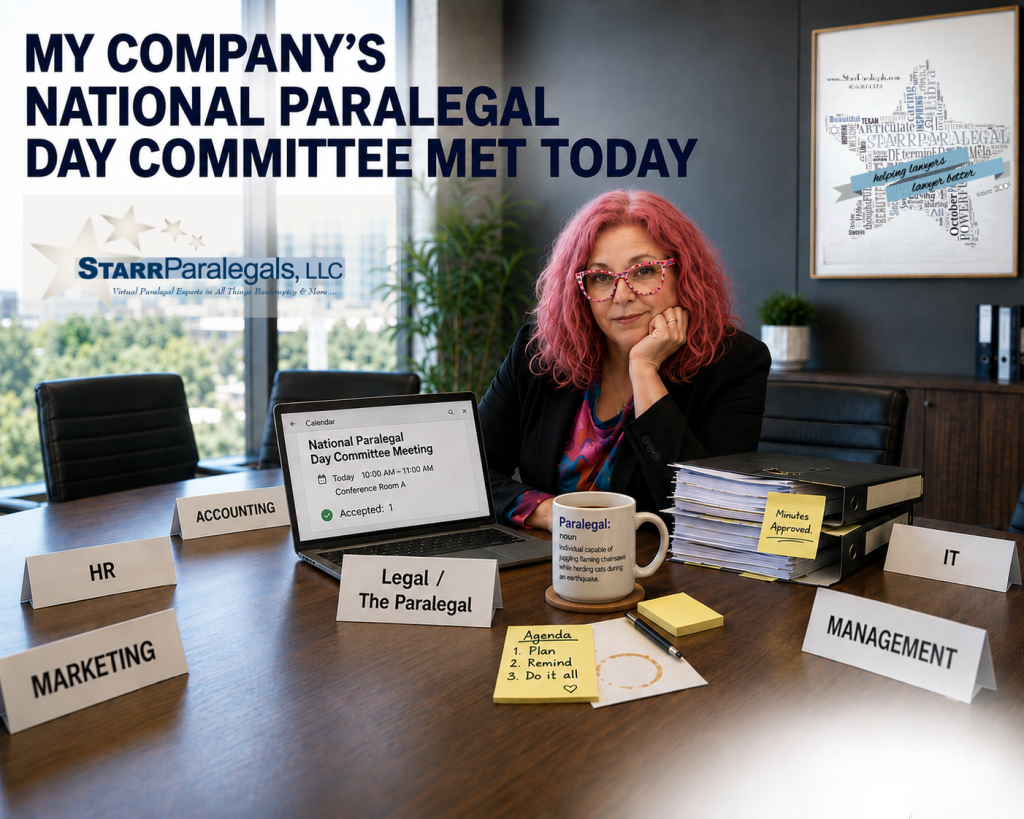
Tomorrow is National Paralegal Day, which creates a unique challenge when you’re both the boss and the paralegal.
Traditionally, this is the day when hardworking paralegals are recognized for their contributions with flowers, lunch, gift cards, and heartfelt appreciation. As the owner of a paralegal business, I fully support this tradition. Unfortunately, as the owner of a paralegal business, I am also responsible for paying for it.
I briefly considered sending myself a Starbucks gift card until I realized I was just moving money from one pocket to another and calling it a celebration. I also thought about emailing all of my clients a friendly reminder that National Paralegal Day was approaching and that their favorite paralegal would certainly appreciate recognition. Apparently that’s called marketing, and somehow even I have standards.
The reality is that paralegals have always worked behind the scenes. We’re problem-solvers, deadline managers, document wranglers, and professional preventers of disasters. Most of our best work goes unnoticed because if we’re doing our jobs correctly, nobody ever realizes there was a problem in the first place.
It’s a strange profession. Success often looks exactly like nothing happened at all.
Somewhere along the way, I think many of us got a little too good at that. We became experts at staying in the background while everyone else stood in the spotlight. Running a paralegal business takes that invisibility and adds another layer. Not only am I the paralegal, but I’m also the receptionist, bookkeeper, marketing department, IT support specialist, and occasional office therapist.
In corporate America, HR might organize a celebration. In my office, HR and Accounting are currently locked in a dispute over whether I deserve lunch. Unfortunately, both departments are me.
In fact, my company’s National Paralegal Day Committee met today.
HR: Pamela deserves recognition.
Accounting: The budget is tight.
Marketing: We should definitely post something.
Legal: Let’s not make it weird.
IT: While we’re here, we’d like to discuss the recent phone-throwing incident.
Management: We’d also like to discuss the recent phone-throwing incident.
Employee: I’d like a raise.
Accounting: Denied.
Employee: I’d also like it noted that I’m a Paralegal Extraordinaire.
Accounting: Duly noted. Denied.
HR: For the record, we agree she’s a Paralegal Extraordinaire.
Accounting: We’re not disputing her qualifications. We’re disputing the budget.
After a lengthy review process, the committee unanimously confirmed what I’ve been saying all along: I am, in fact, a Paralegal Extraordinaire.
Accounting would like the record to reflect that no budget was allocated for this determination.
So this year, I’ve decided to recognize my favorite paralegal. She’s tired. She’s overworked. She occasionally expresses herself through sarcasm. She may or may not have recently launched a cellphone across a room.
But she shows up every day, solves impossible problems, figures things out, and keeps moving forward. She built a business. She helps people navigate some of the most stressful moments of their lives. She somehow manages to do the jobs of six different departments while occasionally pretending she’s only one person.
She is, according to a completely impartial committee consisting entirely of herself, a Paralegal Extraordinaire.
Honestly, that’s worth celebrating.
Happy National Paralegal Day to all the unseen heroes, especially the ones who have to buy their own gift. And if nobody else remembers to celebrate you tomorrow, maybe take five minutes and do it yourself.
Not because anyone owes you flowers.
Because you’ve earned them.
And to my fellow paralegals: I see you.
Leave a commentOctober 8, 2023 — At Last
January 28, 2026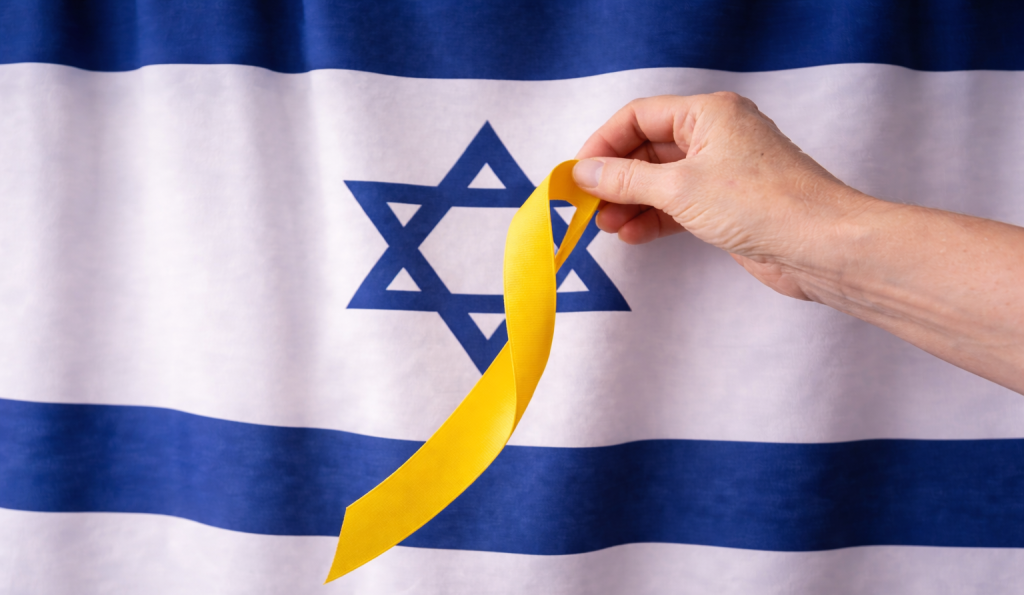
This was written on late in the day on January 26, 2026 and intentionally posted after International Holocaust Remembrance Day — a moment when history, memory, and the present collided in ways I’m still processing.
Today feels like an exhale that’s been trapped in the body for far too long.
For the first time since October 7, 2023 — after 843 days — there are no hostages in Gaza.
For the first time since 2014, there are no Israelis — living or deceased — being held there.
Read that again. Slowly. Let it land.
No hostages.
It has been over two years of holding our breath.
Two years of counting names, faces, ages.
Two years of birthdays missed, lives frozen mid-sentence, families suspended in time.
Two years of yellow ribbons looped around our wrists, our fences, our social feeds, our hearts.
Eight hundred and forty-three days of learning how to function while a piece of our collective soul was somewhere else — underground, in darkness, in terror.
And now — today — they are home.
All of them.
The relief is real.
The joy is real.
The pain is real.
The grief is real.
They are not opposites. They are roommates.
I didn’t expect the tears to come like this — not quietly, not politely. They arrived in waves, uninvited and unstoppable. The kind of crying that comes from somewhere older than language. Somewhere communal. Somewhere ancestral.
When Hatikvah plays, it does what it always does — it bypasses logic and goes straight to the marrow. The same with Habayta. Songs about hope and home land differently when hope has been rationed and home has felt conditional.
Today, they cracked something open that has been sealed tight for survival.
I watched the videos.
People retiring their yellow ribbons.
Untying knots that had become muscle memory.
Folding them carefully. Some kissed them. Some pressed them to their chests. Some couldn’t finish without breaking down.
I had to stop watching.
Because today was also the day I finally turned off the menorah.
It had stayed fully lit in my window since the end of Chanukah 2023 — long after the holiday ended. Long after it made sense on a calendar. It wasn’t decoration. It wasn’t ritual.
It was a vigil.
A refusal to let the light go dark while our people were still waiting.
Every night, it glowed.
And today — for the first time — it felt permissible to let it rest.
Not because the story is over.
Not because the wounds are healed.
Not because justice has been done, or the dead restored, or the trauma erased.
But because the waiting — that particular agony — has ended.
There is a unique cruelty in waiting without end dates. In counting days without knowing how many there will be. In waking up each morning and checking the same headlines with the same dread and the same fragile thread of hope.
After 843 days, that chapter has finally closed.
What opens next is complicated.
There will be reckoning.
There will be mourning.
There will be rehabilitation — physical, psychological, spiritual.
There will be anger that has nowhere tidy to go.
There will also be joy that feels guilty.
Relief that feels fragile.
Smiles that collapse without warning.
That doesn’t make any of it wrong.
It makes it human.
It makes it Jewish.
We are allowed to cry today.
We are allowed to breathe today.
We are allowed to say finally — and mean it without apology.
And we are allowed to hold the names of those who didn’t make it home alongside the unbearable miracle that others did.
Tonight, the menorah is dark.
But the light it stood for — the insistence on life, on return, on am yisrael chai even when it felt impossibly heavy — hasn’t gone anywhere.
It has simply moved back inside us.
Welcome home.
All of you.
